
What Probate Covers in Warren County
Probate is the court process that handles what a person leaves behind and the people who cannot fully handle their own affairs. In Warren County, the Probate Court oversees estates, wills, and the transfer of property after a death. It also handles living matters. Guardianships, name changes, adoptions, trusts, mental illness cases, and marriage licenses all run through this court. The work is wide. One file might settle a deceased person's home and bank accounts, while the next sets up a guardian for an elderly adult who can no longer make safe choices.
Warren County Probate Court sits inside the Probate/Juvenile Division of the Court of Common Pleas. The office is at 900 Memorial Drive in Lebanon, which is a different building from the main Clerk of Courts at 500 Justice Drive. That split matters. People who need a marriage license, an estate file, or a guardianship form go to Memorial Drive, not Justice Drive. The same court also runs the juvenile docket and a detention center, so the building serves more than probate alone.
Adoption is a special case. The Probate/Juvenile Division handles adoptions, but those files are confidential under Ohio law. They are not open probate records, and the court does not release adoption case details to the public.
Probate Terms Defined
Probate uses words that rarely come up in daily life. A few short definitions make Warren County probate records much easier to read. The terms below show up on wills, estate filings, and guardianship cases across the county.
- Testator
- The person who made the will. When the testator dies, the will is filed with Probate Court.
- Executor
- The person named in a will to carry out its terms, pay debts, and pass on property.
- Administrator
- The person the court appoints to manage an estate when there is no will or no named executor.
- Intestate
- Dying without a will. The estate then passes under Ohio's intestacy rules.
- Guardian
- A person the court names to make decisions for someone who cannot make them alone.
- Ward
- The adult or minor placed under a guardian's care and protection by the court.
- Fiduciary
- Any person, such as an executor, administrator, or guardian, who must act in the best interest of others.
An executor and an administrator do much the same job. The name just depends on whether a will named the person or the court did.
How to Search Warren County Probate Records
Searching probate records here works a little differently from the Common Pleas case search. The Probate/Juvenile Division lists an online record search on its site, but that tool was not working at the time of review. The official link returned an "Under Construction" message. So the most reliable path right now is direct contact with the court. You can call, visit the office at 900 Memorial Drive, or use the court's forms and public records request form for case files.
The court's main pages explain what it handles and how to reach each section. Start there to confirm which division holds your file.
The Warren County Probate/Juvenile landing page links the legal help center, forms, cost deposit schedule, local rules, and the public records request form.
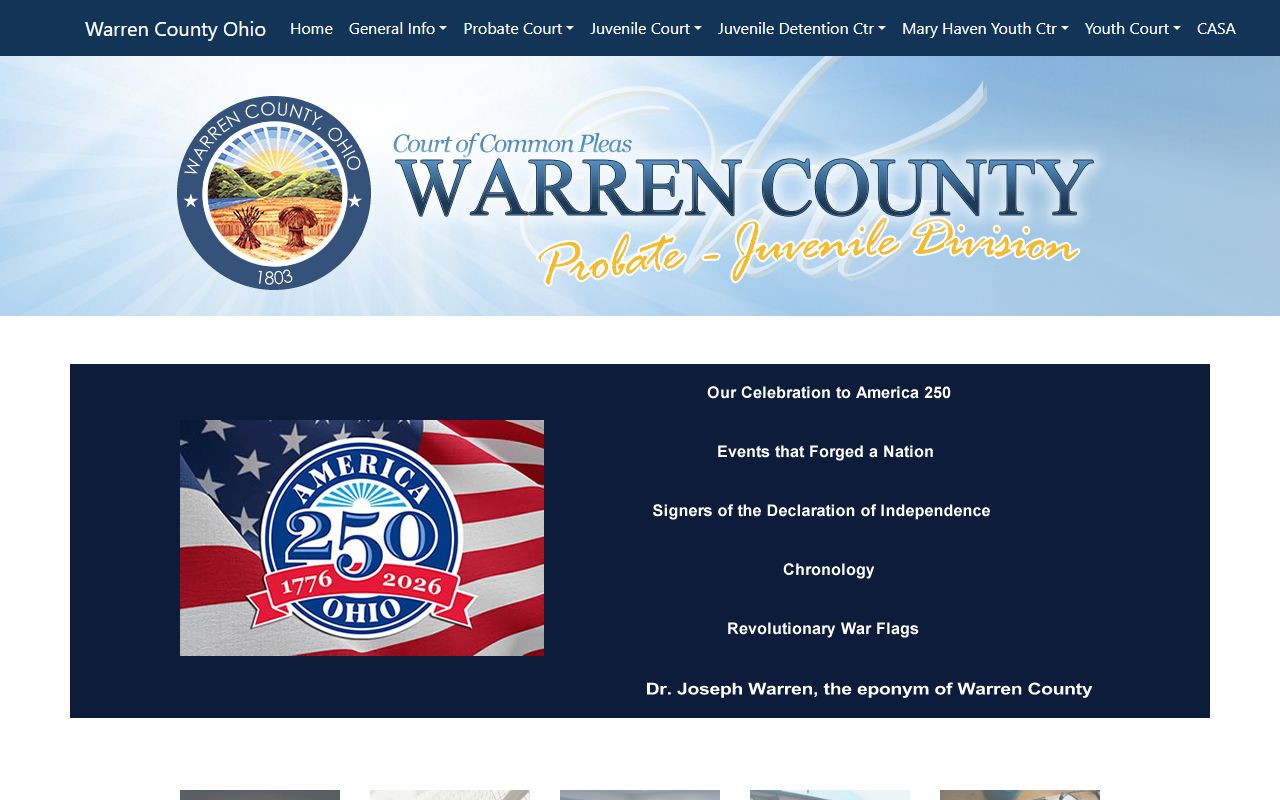
That landing page is the hub for Warren County probate records, juvenile cases, and the request form you use when files are not posted online.
- Decide which file you need. Estate, will, guardianship, name change, trust, mental illness, or marriage each follow a separate track.
- Try the court's online record search, then expect it may be offline. The official portal returned an under-construction notice at review.
- Call the Probate Court at 513-695-1183 with the name and approximate date to confirm the file exists and is open.
- For marriage copies, use the same number or the marriage information line, and bring or mail the copy fee.
- For estates and guardianships, use the court's forms, form packets, and public records request form on the landing page.
- Visit 900 Memorial Drive in Lebanon during business hours if you need to inspect a file in person.
Note: The probate online record search may be unavailable, so call 513-695-1183 or visit the office before you assume a Warren County probate record cannot be found.
Probate Court in Warren County
Warren County has one probate court, and it shares a building and a division with the Juvenile Court. This is the office for estates, guardianships, adoptions, name changes, trusts, mental illness matters, and marriage licenses. It is part of the Court of Common Pleas structure, but users treat it as a separate path because the work and the address differ from the general civil and criminal divisions. The contact card below has the address, phone, and main site for the court.
Warren County Probate Court
Probate/Juvenile Division
900 Memorial Drive
Lebanon, OH 45036
513-695-1183
Mon-Fri 8:00 AM-4:00 PM
The marriage office asks people to arrive by 3:45 PM so the application can be finished before the doors close at 4:00 PM. A separate marriage information line, 513-695-1771, answers license and copy questions. If either person seeking to marry is under 18, the court says to call Warren County Juvenile Court at 513-695-1160 for guidance.
The Probate Process Step by Step
Settling an estate is not a single act. It is a set of steps the court guides from start to finish. The path depends on the size of the estate, whether a will exists, and how the assets are held. Some property never enters probate at all. Below is the general flow Warren County families follow when they open and close an estate.
- Decide whether probate is even needed. Assets with a named beneficiary, survivorship, a trust, or transfer-on-death often pass outside probate. Property held only in the dead person's name usually requires estate administration.
- Find the will. If there is a will, file it with Probate Court. If there is no will, the estate moves forward under Ohio's intestacy rules.
- Pick the right estate process. Ohio offers full administration, relief from administration, and small-estate options based on value, surviving spouse and funeral assignments, and asset type.
- File the application or packet and pay the deposit. Use the county's probate forms and the cost deposit schedule.
- Let the court appoint a fiduciary. The court names an executor or administrator if the estate needs one.
- Manage the estate. The fiduciary files an inventory, notifies heirs and creditors, handles assets, and pays approved debts.
- Account and close. Final accounting and closing filings end the estate unless the court waives or simplifies the steps.
Each step can carry forms, hearings, and deadlines. Many people hire a lawyer for full administration, while small estates can be simpler. The court's forms and form packets line up with these steps.
Guardianship and the Education Rule
A guardianship gives one person legal power to make choices for another. The court may name a guardian for an adult who can no longer manage health or money, or for a minor who needs care. Warren County reviews each case and can split the role into guardian of the person, guardian of the estate, or both. Records may be public in part, but medical evaluations and other sensitive details can be held back.
Ohio adds a training step for adult guardians. Under Supreme Court of Ohio rules, a person who serves as an adult guardian must complete guardianship education. Warren County links the course schedule, the Rules of Superintendence, talking points, an FAQ, and the registration tools used to take the training. This rule helps make sure guardians know their duties before they act for a ward.
Minor guardianships and minor estates use their own forms and court review. So a guardianship for a child follows a different packet than one for an adult.
Probate and Marriage Fees in Warren County
Probate fees depend on the type of case, and the court uses a cost deposit schedule for estates and other filings. The exact deposit amounts come straight from that schedule, which you get from the court. Two fees that are clear from the marriage page appear below. A marriage license is fifty dollars, and a certified marriage copy is two dollars. Keep these separate from the Common Pleas case copy fees, which the Clerk of Courts sets on a different schedule.
| Item | Amount |
|---|---|
| Marriage license | $50.00 |
| Certified marriage copy, cash or money order | $2.00 per copy |
| Certified marriage copy, credit card | $2.00 per copy plus transaction fee |
| Personal checks | Not accepted |
| Estate, guardianship, and other probate filings | Per court cost deposit schedule |
Certified marriage copies can be requested in person, by phone at 513-695-1183 with a credit card, or by mail with the request, the payment, and a self-addressed return envelope. The marriage license itself is valid for 60 days in Ohio and only in Ohio. If it is not used in time, it expires and the couple must apply again.
For estate and guardianship filing deposits, ask the court for the cost deposit schedule, since those amounts are set in a separate document and can change.
Marriage Licenses Through Probate Court
Marriage licenses in Warren County come from the Probate Court, not the Clerk of Courts. Both people must come in together to apply. Ohio residents who marry in Ohio get the license in the county where one of them lives. People from out of state who marry in Ohio get it in the county where the wedding will take place. The license is issued the same day once the application is done.
The marriage page lists the items an applicant should bring and the process for getting a certified copy after the wedding.
The Warren County Probate Court marriage license page sets out the required documents, the fee, the hours, and how to order certified marriage copies.
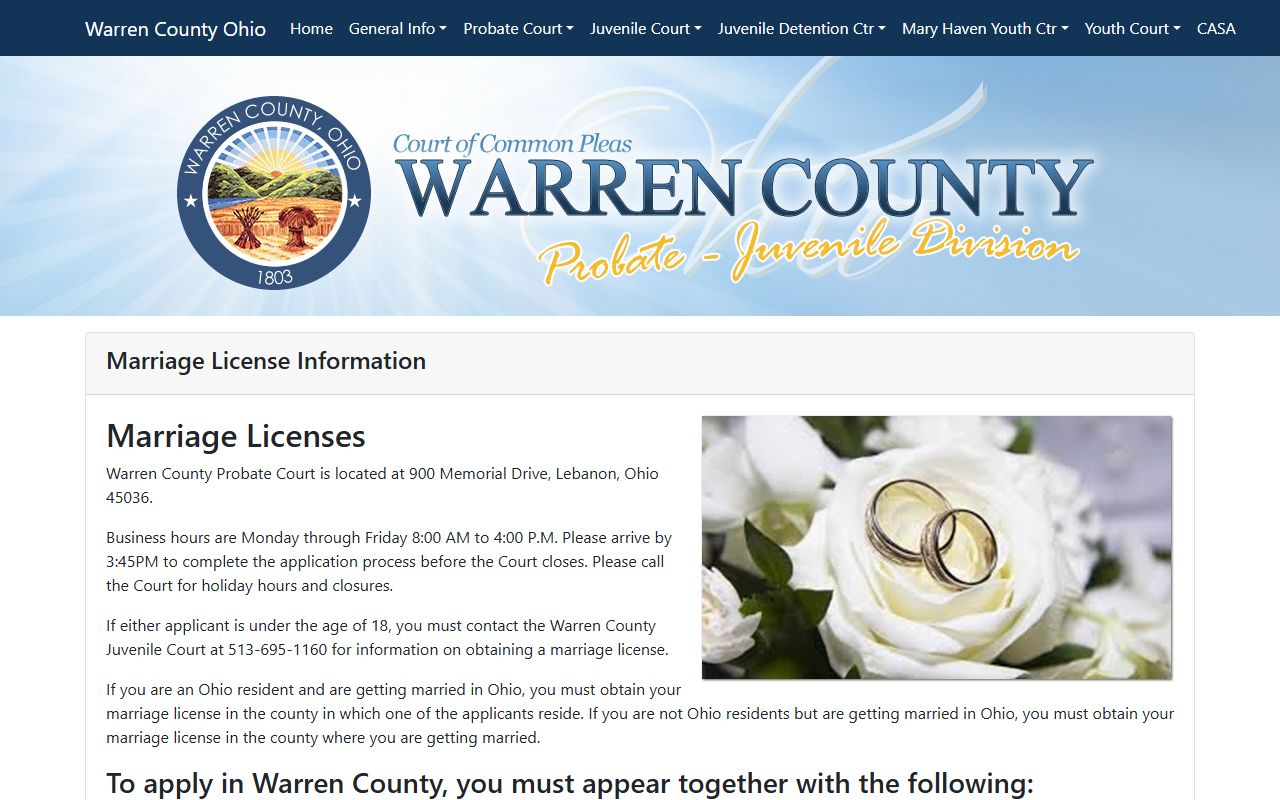
That marriage page is the official source for Warren County probate records tied to marriage, including the license fee and the certified copy steps.
Applicants should bring a government photo ID, proof of residency for at least one person, a time-stamped copy of the most recent divorce decree if either was divorced, and a deceased spouse's name and date of death if widowed. For the full divorce side of these records, see marriage and divorce records, since divorces are Common Pleas Domestic Relations cases held by the Clerk.
What Warren County Probate Records Show
A probate file is built from many fields. Most cases carry a case number, a case type, the names of the people involved, key dates, and a list of docket entries. The fields shift with the case kind. An estate names a decedent and a fiduciary, while a guardianship names a ward and a guardian. The list below shows the data points you tend to find on a Warren County probate record.
- Case number and type - estate, guardianship, trust, name change, adoption (restricted), marriage, or mental illness.
- Party names - the decedent, ward, or applicant, plus the fiduciary or guardian.
- Dates - filing date, hearing dates, and inventory or accounting dates.
- Court staff - the judge or magistrate and the attorney on the case.
- Docket entries - applications, orders, letters of authority, and accountings.
- Bond and money fields - bond information and amounts tied to the estate.
Estate files often include wills, inventories of property, lists of debts, and final accountings that show how assets were split. Letters of authority prove that an executor, administrator, or guardian has the legal power to act. Because the online search was offline at review, expect to confirm these fields with the court directly.
Restricted Probate Records
Not every probate file is open. Adoption records are confidential under Ohio law, so the court does not release them as public probate records. Mental illness matters are sensitive, and the court can limit who sees them. Guardianship files may be partly open, but medical evaluations and other private details about a ward can be sealed. Minor cases get extra care because they involve children.
Ohio's adoption confidentiality rule sits in the state code. It treats adoption files as private rather than as ordinary public records.
You can read the rule at Ohio Revised Code Section 3107.17, which makes adoption records confidential and limits who may access them.
To view a sealed or restricted file, a person usually must show a legal basis and ask the court that handled the case. "Confidential" is not a matter of office preference. It rests on a statute, a rule, or a court order. When a file is not posted online, that does not mean it is secret. Many open probate records simply require an in-person visit or a written request to the court.
Public Record Search
Sponsored Results