
How to Find Recent Warren County Arrests
The fastest way to confirm a recent arrest is the jail roster. The Warren County Sheriff runs the jail at 822 Memorial Drive in Lebanon. People booked by a county agency often land there first. The Sheriff points to an online current-custody tool hosted on the Miami Valley Jails site. That tool lists who is held right now in the listed jail. It updates about every 30 minutes. It does not act as a full criminal history, and it does not show people held in other jails.
Search the roster by last name or first name. There is also an A to Z browse by last name. The portal may ask you to pass a quick security check before it shows results. The roster is custody data, not court data. To follow a case after booking, you move to the court docket. For the full roster steps, money and mail rules, and visitation, see Warren County inmate records.
- Open the Sheriff's current-custody tool on the Miami Valley Jails site.
- Type a last name, a first name, or both in the search bar.
- Or browse the A to Z last-name links to scan the roster.
- Pass the security check if the site asks you to prove you are human.
- Open the listing to view booking data for that person in custody.
Note: The jail roster shows current custody only, so a person released or moved to prison may no longer appear there.
Arrest Records vs Criminal Court Records
People mix these two up all the time. An arrest record comes from law enforcement. It captures the arrest event, the booking, and the early charge an officer or agency lists. A criminal court record comes from the court. It starts once a prosecutor files a charge and a judge opens a case. The two can tell very different stories. An arrest does not mean a charge will be filed. A filed charge does not mean a conviction. Read both with care.
Arrest data in Warren County mostly lives with the Sheriff and the booking jail. Court data lives with the Clerk of Courts and the courts that hear the case. For felony case history, the Common Pleas records are the source. For the broader picture of a case, see the Warren County court records page.
| Arrest Record | Criminal Court Record |
|---|---|
| Created by law enforcement at arrest or booking | Created by the court when a charge is filed |
| Held by the Sheriff and booking jail | Held by the Clerk of Courts and the court |
| Shows arrest, booking, and early charge | Shows filings, pleas, rulings, and the final outcome |
| Best checked through the jail roster | Best checked through the court docket search |
| Does not prove guilt | Shows whether a conviction was entered |
What Warren County Arrest Records Show
Arrest and booking data is built from fields. The jail roster, before any security check, shows the jail code, the jail name, the current population, the jail phone, the update time, and search fields. Once you open a listing, a profile commonly carries the person's name, a booking number, age, custody status, the booking date, the listed charges, bond, and housing. The exact set depends on the system and on what the jail makes public.
Charges on an arrest record are the early version. They can change. A prosecutor may add, drop, reduce, or amend a charge later. The court docket is where those changes show up. So treat the arrest charge as a starting point, not a final word.
| Field | What It Shows |
|---|---|
| Name | The booked person's full name, sometimes with aliases. |
| Booking Number | The number the jail assigns to the booking event. |
| Booking Date | The date the person was booked into custody. |
| Charges | The early charges listed at arrest, which may change later. |
| Bond | The amount or condition set for release, if any. |
| Custody Status | Whether the person is held, released, or transferred. |
Note: Some profile fields may sit behind a security check, so not every field is visible without passing it first.
Charges vs Convictions in Warren County Records
This is the part people miss most. A charge is an accusation. A conviction is a finding of guilt. A person can be charged and never convicted. The case may be dismissed, reduced, or amended. A jury or judge may find the person not guilty. The arrest record and even an early court entry only show the charge. The final entry on the docket shows how it ended.
Felonies in Warren County are prosecuted in the Court of Common Pleas. The County Prosecutor handles felony cases there. A felony is a crime that can bring more than one year in jail or prison. Misdemeanor and traffic charges run through County Court or a municipal court. To read a charge correctly, follow the full docket through to the disposition.
| Charges | Convictions |
|---|---|
| An accusation filed against a person | A formal finding of guilt by a court |
| Can be dropped, reduced, or amended | Entered after a plea, trial, or verdict |
| Appears at arrest and early in a case | Appears in the sentencing or judgment entry |
| Does not prove wrongdoing | Carries a sentence or penalty |
Public Access and Ohio Records Law
Ohio law leans toward openness. The Ohio Public Records Act sets the base rule, and court records add their own rules on top. Most arrest and court data is public. You usually do not need to give a reason to inspect a record. But arrest and booking data can have limits. Confidential law-enforcement investigatory records may be held back while a case or appeal is active. The Ohio Attorney General explains the state's Sunshine Laws in plain terms.
The Ohio Attorney General's office maintains a public-records overview that backs up the open-records presumption.
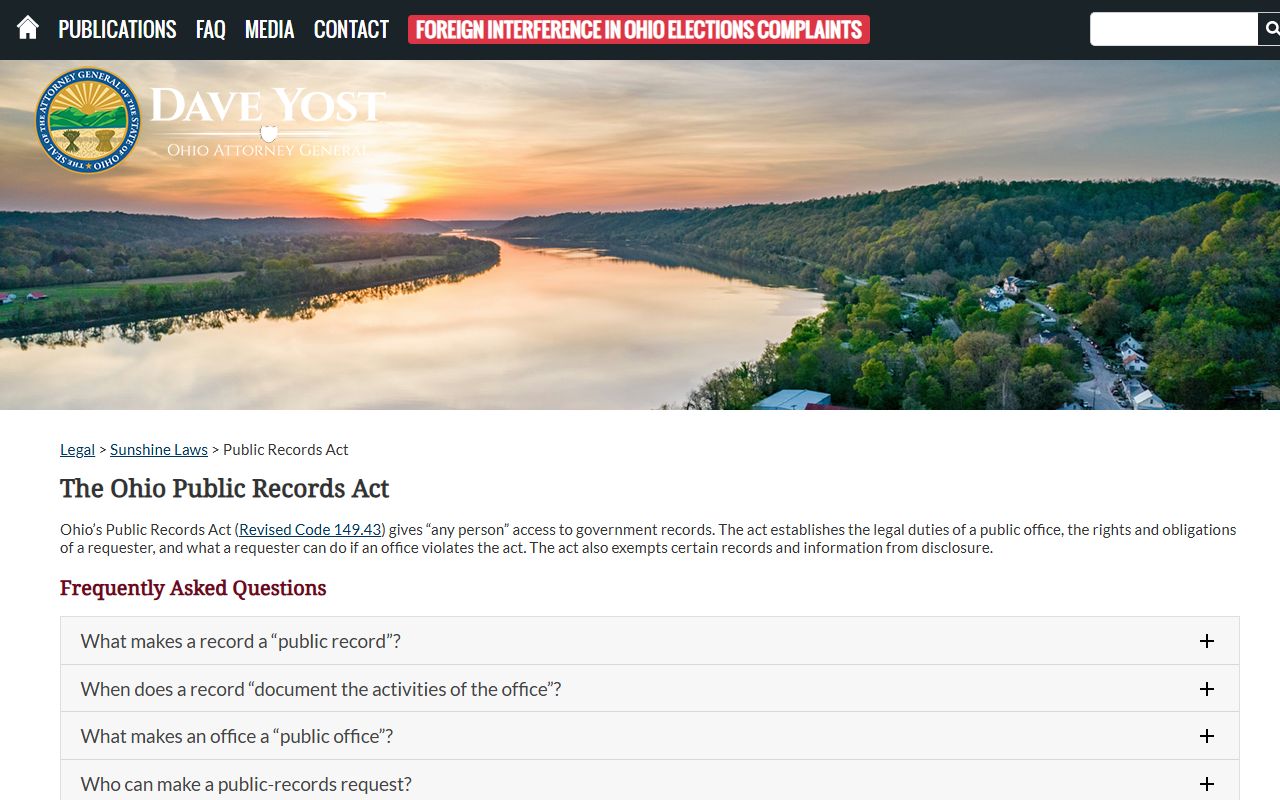
That Ohio Attorney General Public Records Act page describes how any person may ask a public office for records, which shapes how arrest data is released in Warren County.
Key Statutes:
Ohio Revised Code § 149.43 - Ohio's Public Records Act; gives any person the right to inspect and copy public records, with listed exemptions for certain law-enforcement material.
Ohio Rules of Superintendence 44-47 - define court records and set the presumption of public access to case documents.
Sealing and Expungement of Warren County Records
Some criminal records can be sealed or expunged in Ohio. Sealing limits public access to a record. Expungement, under current Ohio law, can involve destroying or deleting the official record where the law allows it. The rules sit in Ohio Revised Code Chapter 2953. The person applies in the court that handled the case, gives notice to the prosecutor, and may attend a hearing. The court weighs eligibility, waiting periods, and any objections.
Not every record qualifies. Section 2953.32 covers sealing or expunging a conviction. Section 2953.33 covers relief after a dismissal, a not-guilty finding, a no bill, or a pardon. Section 2953.36 lists offenses that stay ineligible. So no one should assume every arrest or charge can be cleared. Warren County Common Pleas links separate sealing packets for convictions and for dismissals, and the fee schedule lists a sealing charge.
The official text of Ohio's sealing and expungement chapter is published by the state.
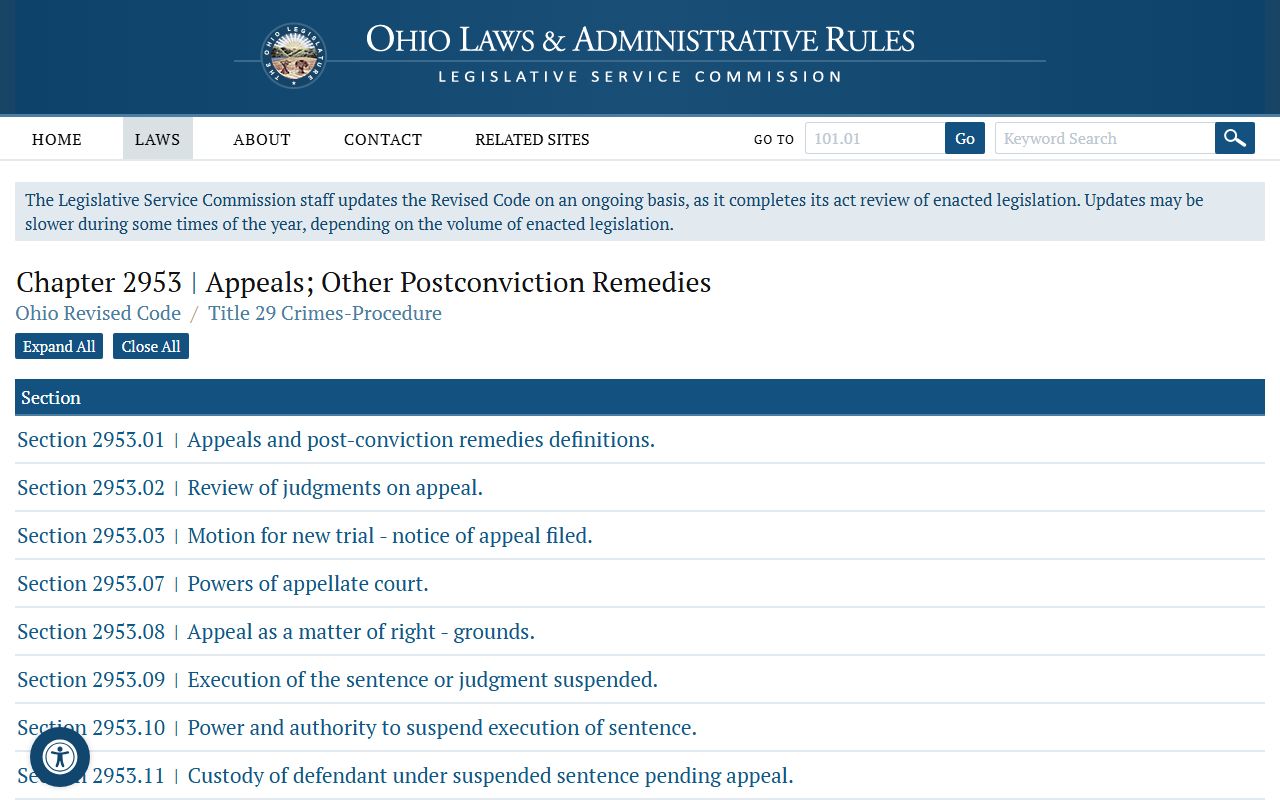
The Ohio Revised Code Chapter 2953 page lays out who may apply to seal or expunge a Warren County record and the limits that apply.
| Sealed | Expunged |
|---|---|
| Limits public access to the record | May destroy or delete the official record where allowed |
| Record still exists in the system | Record is removed under the statute's terms |
| Courts and some agencies may still view it | Access is far more restricted once granted |
| Governed by ORC Chapter 2953 | Governed by ORC Chapter 2953 |
A sealed record does not vanish from every system. Courts, law enforcement, and some licensing agencies may still see it for limited, lawful reasons. For court-side detail on sealing, see the court records page.
Juvenile Arrest and Record Limits
Juvenile records are not handled like adult records. Ohio treats them with more privacy. Delinquency, dependency, and juvenile traffic matters run through Juvenile Court. These files can have public docket pieces, but access is often limited to parties, counsel, agencies, or those a court allows. So a juvenile arrest does not show up the same way an adult booking does.
Two statutes guide this. Section 2151.14 covers juvenile court records. Section 2151.356 covers sealing of juvenile records, including age and case-status rules. Anyone seeking a juvenile record should expect a statutory access check, not open browsing.
The state publishes the juvenile sealing statute in full.
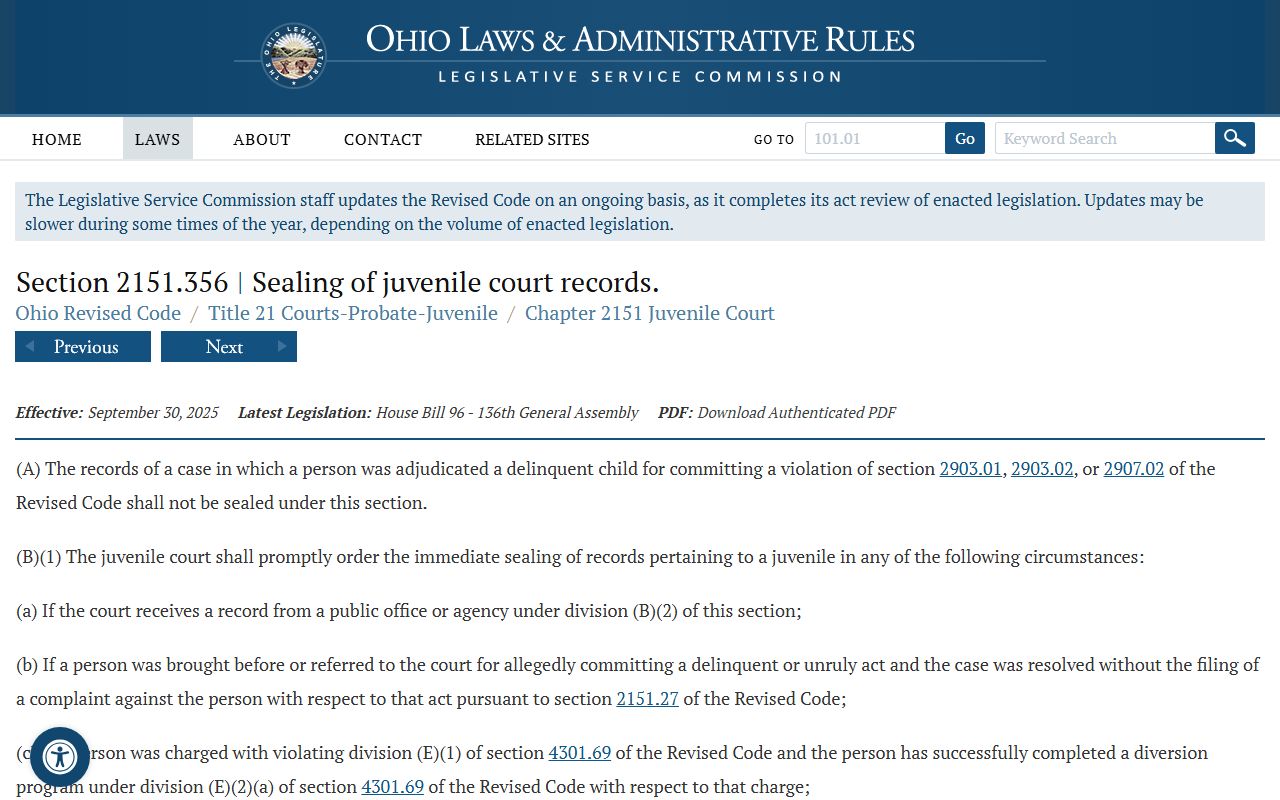
The Ohio Revised Code § 2151.356 page sets the rules for sealing a juvenile record tied to a Warren County case.
Mugshots and Booking Photos
A booking photo, often called a mugshot, is taken during the booking step. In Warren County, booking happens at the jail after an arrest by a county agency. Booking usually includes identification, a booking photo, a property inventory, medical and security screening, and charge or warrant entry. Whether a booking photo is posted online depends on the agency and the system.
The current-custody roster is the place to check for live booking data. A mugshot, where shown, sits with that record while the person is in custody. Once the person is released or moved, the live roster may drop the listing. A mugshot is tied to an arrest, not a conviction, so it carries the same caution as any arrest record.
Background Checks vs County Arrest Data
An arrest search and a background check are not the same thing. The county jail roster and the court docket show local custody and case data. A formal criminal-history background check is a separate system. In Ohio, that runs through the Bureau of Criminal Investigation, which is part of the Attorney General's office, and through the FBI for national checks. Those checks pull from many sources, not just one county.
So a clean county docket does not equal a clean statewide or national record, and the reverse can be true too. A Warren County felony case shows on the Common Pleas docket, while a full criminal-history check is its own process with its own rules. Also note the Fair Credit Reporting Act. This site is not a consumer reporting agency, and county arrest data here cannot be used for credit, employment, tenant, or insurance screening.
Note: County arrest and court data is not a substitute for an official BCI or FBI background check, which pull from separate statewide and national systems.